Cataloguing and Collection Management for Personal Library
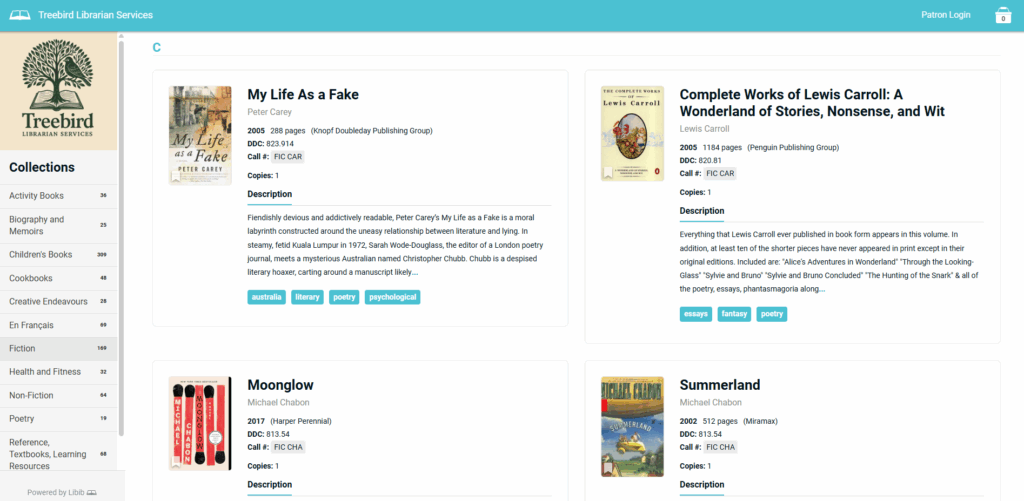
Created a customised collection management system for a personal library of about 1000 unique items. With this system, which uses Libib library software, the user can search for specific items or browse via subject tag filters. Each entry contains an image, a description, subject tags, a Dewey Decimal Classification number, and standard bibliographic information. Each item was labelled with a barcode and a call number in order to easily locate and track items. Fiction collections are organised alphabetically, with call numbers consisting of the first three letters of the author’s name. Non-fiction is organised by DDC, with unique call numbers consisting of Cutter code, first letter(s) of title, and publication date.
Sharepoint File Transfer and Records Creation Project
Created a structured SharePoint-based information management system to serve as a central repository for business documents, incorporating both digitized and born-digital records. Transferred files into purpose-built SharePoint libraries designed to support long-term access, discoverability, and maintenance. Developed SharePoint pages to act as centralized access points for each records collection, organizing information by theme and function. Pages integrate structured lists, internal navigation links, external reference links, and contextual documentation to support user orientation and efficient retrieval. The system is actively maintained, with ongoing additions, metadata refinement, and structural adjustments as business records evolve.
In Process: Genealogical Documents Management using Omeka
Designed and developed a private, web-based genealogical archive to preserve, organize, and provide structured access to family historical records. Personal archival materials have been digitized and uploaded into curated collections, with consistent application of Dublin Core metadata, standardized file-naming conventions, and controlled vocabularies to support discoverability, coherence, and long-term management. Collections are structured to enable intuitive navigation while maintaining archival context.
Handwritten diaries are being transcribed to enhance accessibility and usability. Digitized originals are presented alongside linked transcriptions, allowing users to consult both source materials and readable text versions.
Planned work includes the development of interpretive digital exhibits. At least one diary will be expanded into a full exhibit incorporating images, newspaper clippings, translations (parts of the diary are written in Gaelic), and additional contextual materials not originally contained within the diary. These supplementary resources are identified through independent archival research across multiple external repositories to situate the materials within their broader historical, cultural, and familial contexts. Additional exhibits will be created using this model as the archive continues to grow.
The archive is intended for a defined family audience and is access-controlled due to the sensitive and personal nature of the materials. Authorized users are able to browse collections, consult transcriptions, and explore curated exhibits in a secure environment.
Genetic Genealogical Research
Conducted a genetic genealogy investigation to resolve unexplained Ashkenazi Jewish ancestry identified through commercial DNA testing. The client’s documented family history did not account for this ancestry, and prior research had failed to identify its source.
Using the client’s existing family tree and autosomal DNA match data, the closest genetic matches were identified and independently researched. Trees were constructed for these matches until a shared ancestral line emerged, which was subsequently confirmed through additional DNA matches. DNA evidence was then used to determine where this external lineage entered the client’s family.
The research narrowed the point of entry to the client’s great-great-grandparents and demonstrated that the client was genetically related only to the great-great-grandmother, indicating a case of misattributed paternity. Traditional records initially suggested no opportunity for an alternate paternal line; however, contextual research revealed a previously undocumented period during which the great-great-grandmother lived in New York City.
Using historical address records, the research shifted to the New York City neighborhood where she lived during this period. Nearby households were examined, revealing two brothers bearing the same surname that appeared consistently across the DNA matches’ family trees, along with a sister living in the same area. The elder brother was married and significantly older; the sister’s sons were too young to be viable candidates. The remaining brother—unmarried and close in age to the great-great-grandmother—emerged as the most likely biological great-great-grandfather.
A full genealogical reconstruction was then completed for this individual. His family’s geographic patterns aligned with those identified in the DNA matches, and a living descendant was located who shared a measurable DNA match with the client, providing genetic confirmation of the conclusion.
To contextualize the findings, additional biographical and historical research was conducted on the identified family. This included locating burial information and compiling documentary evidence to provide the client with a fuller narrative of their ancestry. The project combined DNA analysis, documentary research, and contextual historical reconstruction to solve a family mystery and integrate it meaningfully into the client’s family history.